Chamonix does not hide the fact that it sells access to the mountains. The valley sits under a wall of rock and ice that draws people from every continent, and the short main street between the river and the station has spent a century learning how to feed them. It is worth understanding that street as a historical document, because it explains both the crowds you will meet on the trail and the empty paths twenty minutes away.
A village that grew around one view
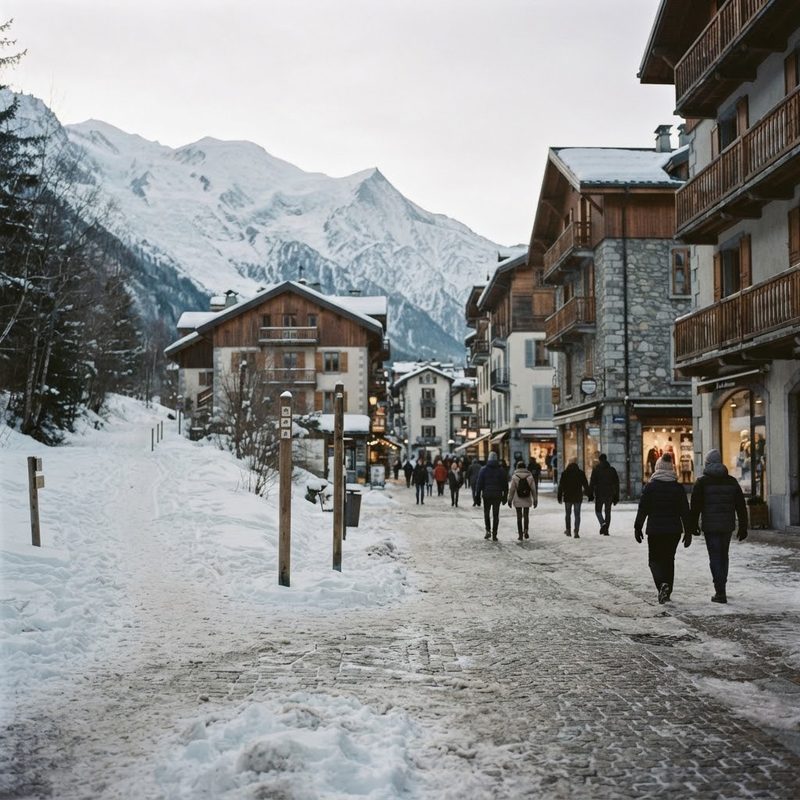
The first outsiders came for guides. Local men knew the ice and the passes, and by the nineteenth century the valley was already hosting British climbers who hired them for the glaciers. Hotels followed the season, then the railway that pushed up the valley towards the Mer de Glace, and the place learned early that arriving guests needed beds, food and someone to show them the ice.
Cable cars finished the transformation in the middle of the twentieth century and made height available to anyone who could pay for a ticket. Suddenly the summit views that had required a two-day climb were a fifteen-minute ride away. The town's centre expanded to service that traffic, and every decade since has added another layer of shops to the same few hundred metres of road.
What the high street sells now
Walk the centre today and the mix reads as a barometer of mountain fashion. Outfitters and rental counters sit where butchers and hardware shops used to be, and the windows rotate through trail shoes, insulated jackets and packs as the season turns. Letting agencies occupy ground floors in nearly every block, because a valley this short has more keys in circulation than long-term residents.
The change is not unique to this valley. Anywhere a national park or a famous massif sits within an hour of an airport, the main street eventually converges on the same inventory: technical clothing, guided experiences, and food that can be eaten quickly between two activities. What makes this street distinctive is the scale of it, packed into a village footprint that was never designed for it.
Look past the retail and the older town is still legible. Stone buildings with deep eaves, a church square that predates the tourism, and side lanes where the shutters stay closed most of the week. The bones are those of a working alpine village, and the current economy sits on top of them rather than replacing them.
The weeks that changed the calendar
Summer used to have a clear beginning and end, and that structure has blurred. Trail running brought a new kind of visitor in numbers the old season never had, including people who arrive for a single race and stay a few nights. Late summer now carries a concentrated burst of activity, with the centre full in the evenings and the trailheads busy from first light.
Event weeks show how completely a town this size can be taken over. Streets close for starts and finishes, shops stock race nutrition for a fortnight, and restaurants take bookings the way they do in high winter. For residents it reads as a second winter season, arriving in warm weather and bringing the same pressures without the snow.
The shoulder periods, in between, are when the place is closest to what it was. Spring and late autumn bring fewer visitors, longer afternoons in the cafes that stay open, and trails where the only other people you meet are those who live there.
Where the locals go instead
Cross the river or climb out of the centre and the crowd thins fast. The ridges on the opposite side of the valley face the massif, which means the classic view is behind you and the footfall is a fraction of what gathers under the cable cars. It is the standard local answer to a busy weekend: go to the side that looks back at the mountain rather than up at it.
The hamlets further along the valley work the same way. A short bus ride drops you at a cluster of houses, a bakery and a lift that serves neither the same queues nor the same ticket price. Trails leave from behind the buildings, and by the time the day visitors arrive most of the good ground has already been walked.
In winter the same logic applies on skis. The valley has more terrain than any single holiday can cover, and the temptation is always to ride the famous lift. Residents tend to start on the quieter faces and save the summit routes for a weekday morning.
The other refuge is timing rather than geography. The same people who walk these paths on a busy Saturday do them at seven in the morning or after five, when the lifts have stopped emptying their queues and the trail belongs to whoever is standing on it. Distance from the centre is only one variable; the hour matters just as much.
Reading the town rather than fighting it
The practical approach is to use the high street for what it is good at: hiring the boots, buying the forgotten gloves, booking a bed and eating late. Then leave it. An early start, a bus to the far end of the valley and a walk that begins away from the main lift will give you the mountain without the queue that comes with it.
That is the useful history lesson a trailhead town offers. The street in front of you is simply a record of what thousands of visitors asked for in each decade, and the ground that has not changed is usually the ground just beyond the last shop.